
Perhaps it was my prejudices that made me first look at the speakers with a shrug. Another pair of speakers to woo the audience with an unabashedly retro design. How about creating something original instead of copying the past, I thought.
No offence. I vaguely remembered the original, which was well received by both the press and the public at the time. But that was over 50 years ago and speakers have undoubtedly improved a lot since then.
So the point of creating a new version of an old design was in my eyes completely lost. But that was until the speakers were carefully placed in our test room.
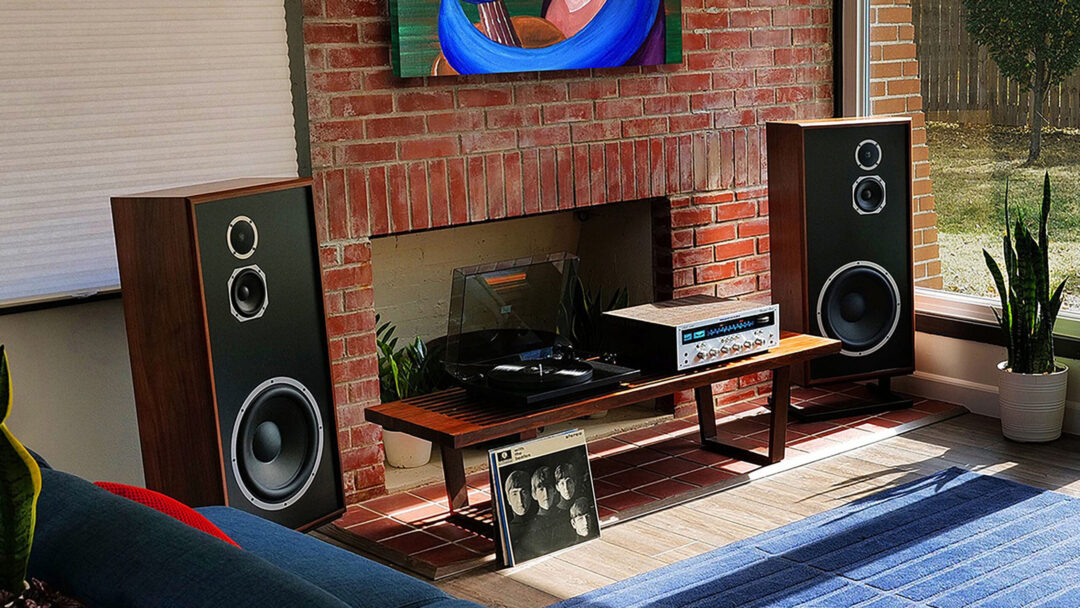
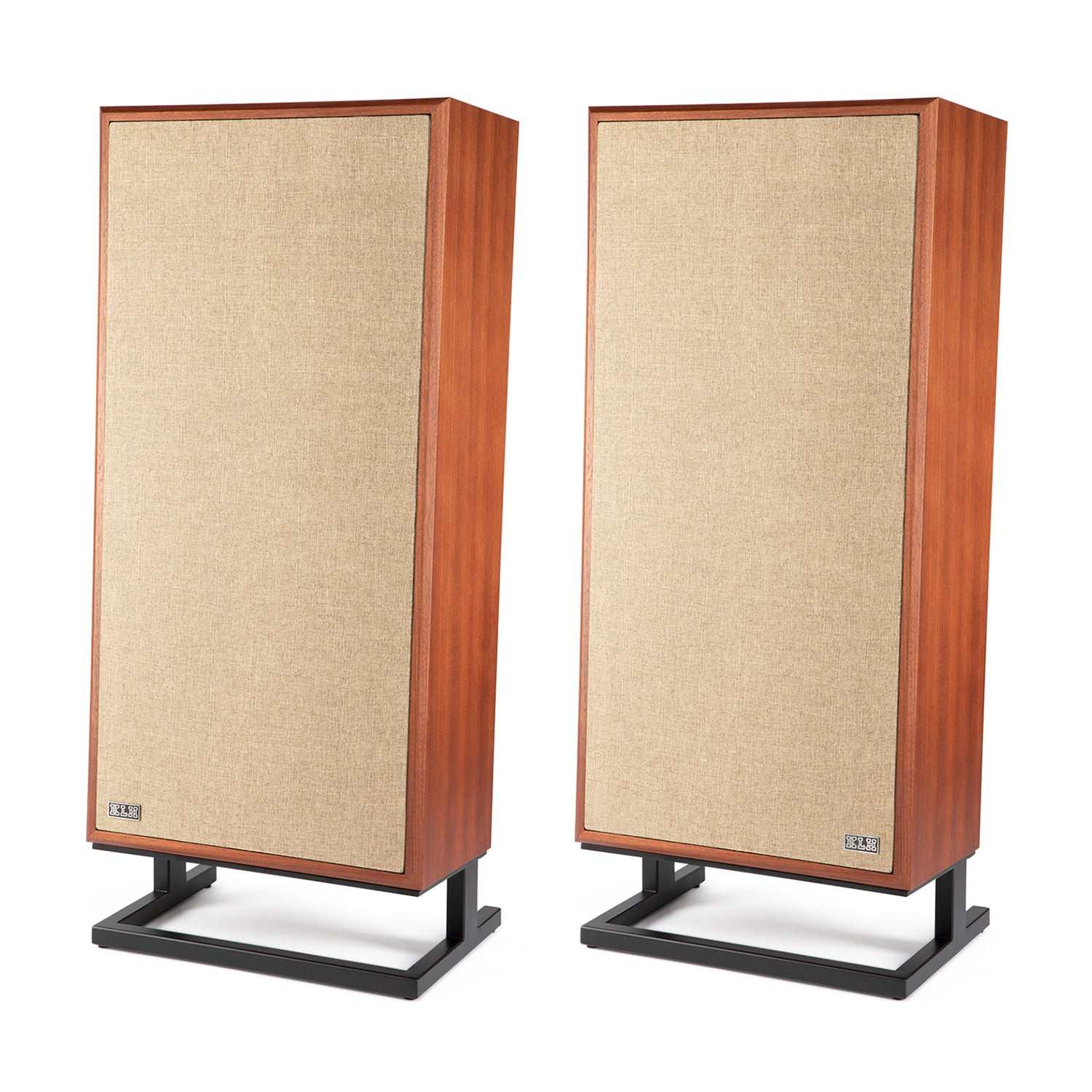
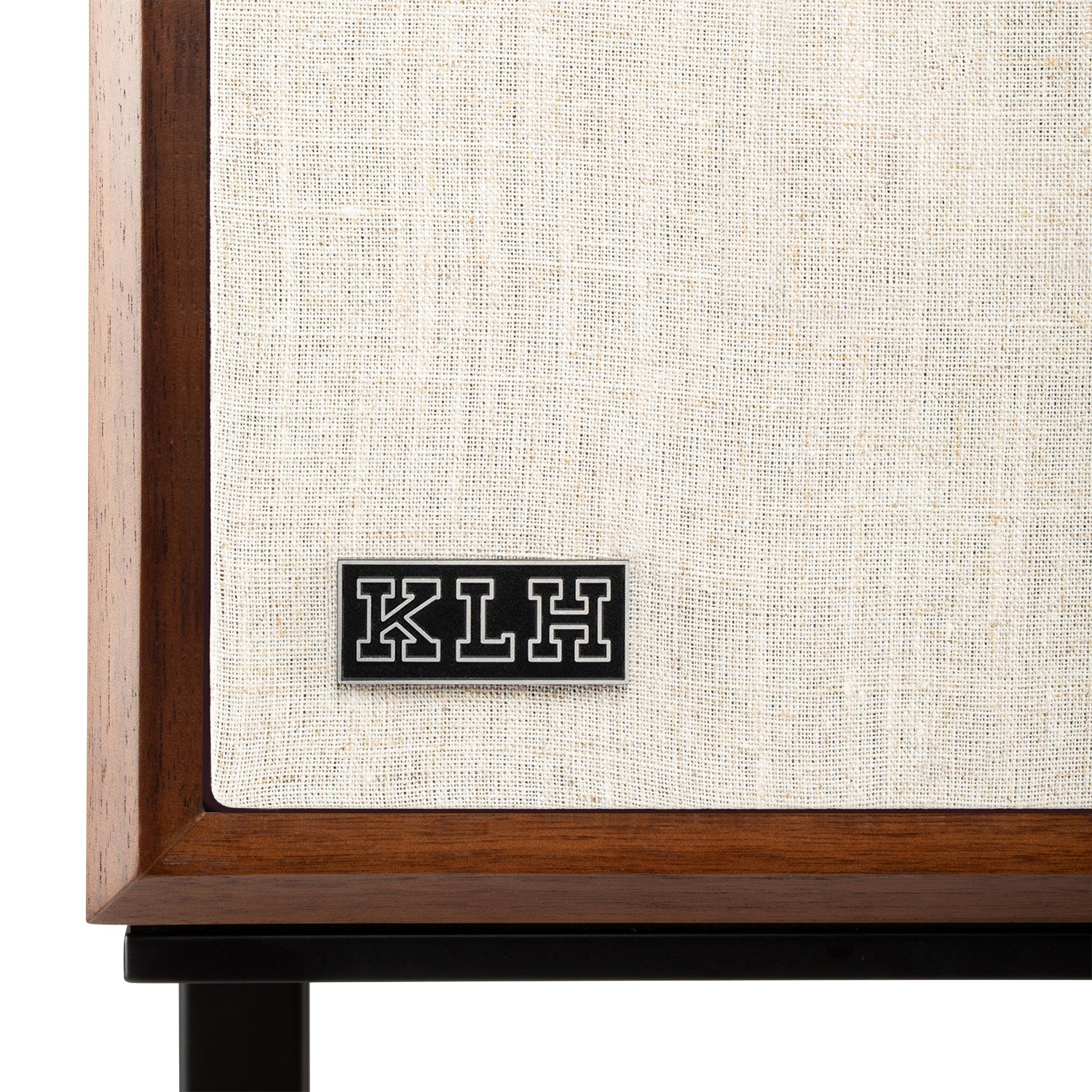
Yes, they certainly look retro as they stand there. Veneered in American walnut with beige grilles covering the black front. A pair of speakers from grandad’s era (and my own tender youth), in a way, slightly reclined on a low floor stand.
But the sound is definitely not from grandad’s time.
The KLH Model Seven is the flagship of the new KLH series, drawing both design inspiration and technical principles from old KLH speakers. But built with today’s materials and electronics.
The first KLH speakers were based on Edgar Villchur’s patented principle of so-called acoustic suspension. Which Villchur first used on the Acoustic Research AR-1 in 1954. Henry Kloss – perhaps best known today for the Tivoli radio – worked for Villchur at Acoustic Research and started his own business in 1957. Henry Kloss then teamed up with Malcolm Low and Josef Hofmann, and the first KLH speakers used the same principle of acoustic suspension.
So does the new Model Seven – and the smaller Model Five.
KLH Model Seven
None of them are directly based on an older KLH model. The Model Seven was originally a compact two-way speaker with a 12-inch woofer and two small tweeters with conical diaphragms.
The modern Model Seven is a much larger three-way speaker. Still with acoustic suspension, i.e. a closed cabinet, in a complete enclosure with a distinctly retro feel
There is absolutely nothing to criticise about the build quality. The cabinets, veneer and drivers are built with confidence, as are the fabric-covered grilles, which are attached with invisible magnets.
The low floor stands are included with the speakers.
Acoustic Suspension
With the stands, the speakers rise more than a metre above the parquet floor. The wide baffle houses a 13″ woofer with a paper fibre cone on an aluminium chassis in a closed cabinet. Acoustic Suspension acts as a shock absorber for the movement of the woofer. Unlike a bass reflex cabinet, where the driver has no significant internal air resistance.
The advantage of this way of damping the woofer is that you get a tight, controlled and linear bass response. The disadvantage is that you lose some of the sensitivity at the lowest frequencies. The Model Seven reaches down to 38 Hz with a -6 dB drop, and all the way down to 26 Hz, but then the drop is significant: -10 dB.
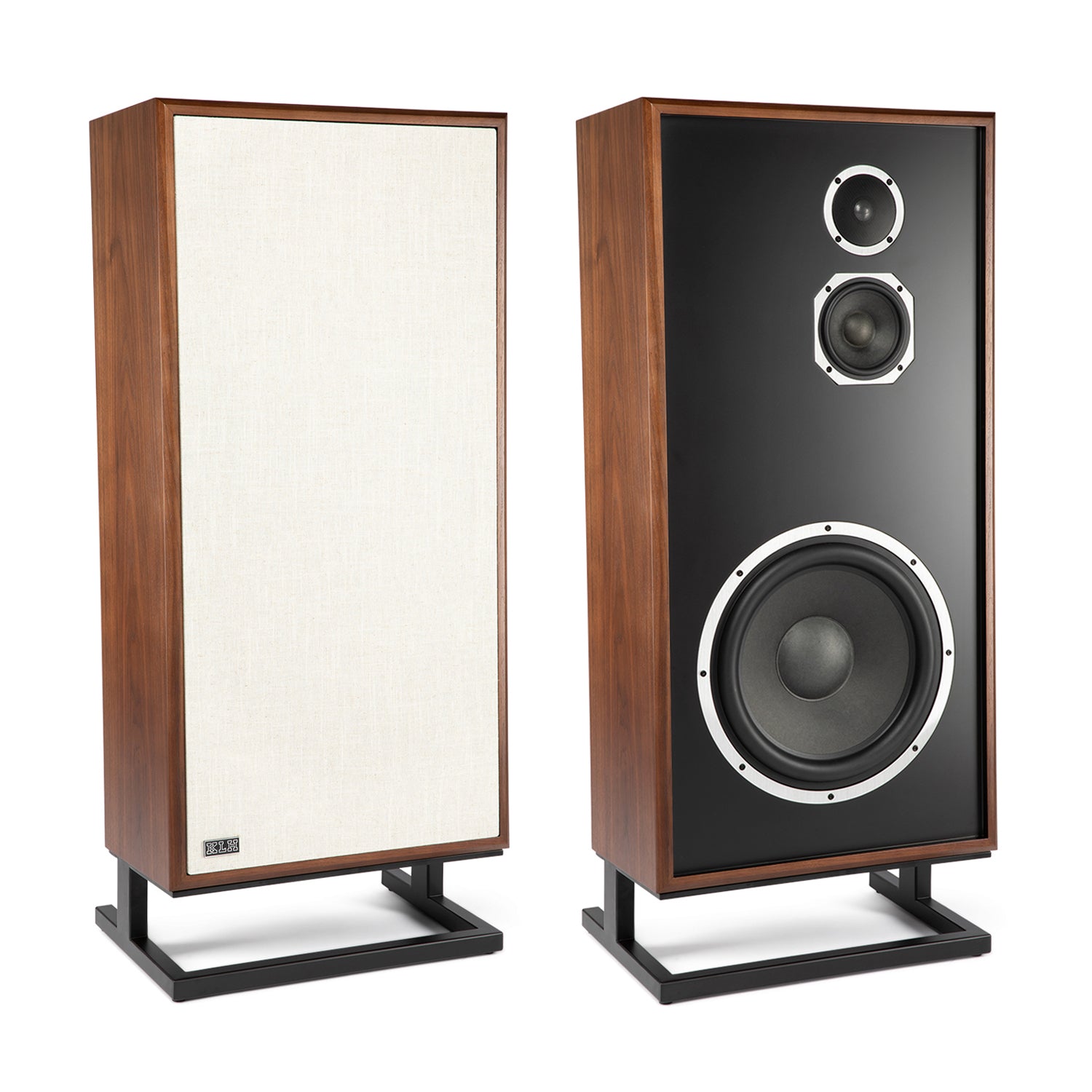
Above the woofer and asymmetrically placed is a midrange driver with a 12.6 cm paper fibre cone and a tweeter with a 25 mm aluminium cone.
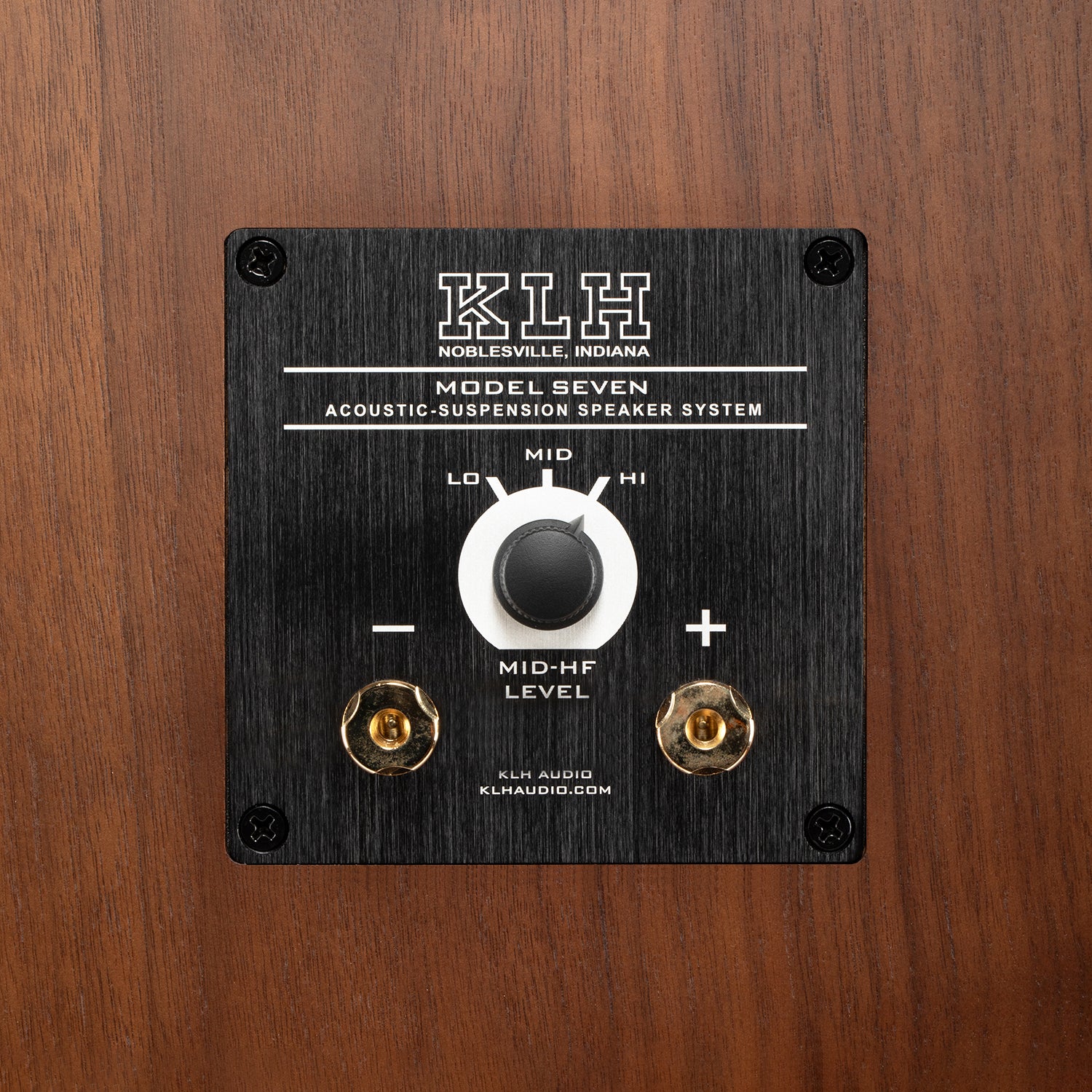
A third-order crossover divides between 300 and 3,500 Hz and there’s a switch on the back to attenuate frequencies above 400 Hz by 1.5 or 3 dB. This is useful if the speakers are in a room with a lot of reverberation, which can result in an overly powerful treble.
The stated sensitivity is 91 dB in a typical living space and with a relatively flat 4 ohm resistance, the speakers are quite easy to drive. In any case, it doesn’t take much to achieve a sound pressure level that few people are comfortable with.
Juicy bass and big soundstage
The same can be said for the MoFi Electronics Sourcepoint 888. A floorstanding speaker in the same price range that delivers much of the same sound pressure as the Model Seven. The 888 has slightly better dynamic contrast, but requires a powerful amplifier to thrive. A pair of Bowers & Wilkins 702 S3 costs a little more and offers a more refined treble reproduction, but is nowhere near the energy or bass punch of the Model Seven.
Here you get an exceptionally large soundstage with an energy almost reminiscent of a PA system.
First impressions were solid to say the least, and after a few weeks of playing it was finally time for some critical listening.
Most of the time we used a Hegel H600, which is a kind of reference in its class. But we also used an integrated hybrid amplifier from the Polish company Circle Audio, which gave us several useful lessons during the test.
Among other things, the speakers actually go deeper in the bass than you might think. Not basement-deep, but more than enough to make the bass on James Blake’s Limit To Your Love threaten to tear the building down. And that’s without the unflattering flutter that can occur in the bass port of bass reflex speakers.
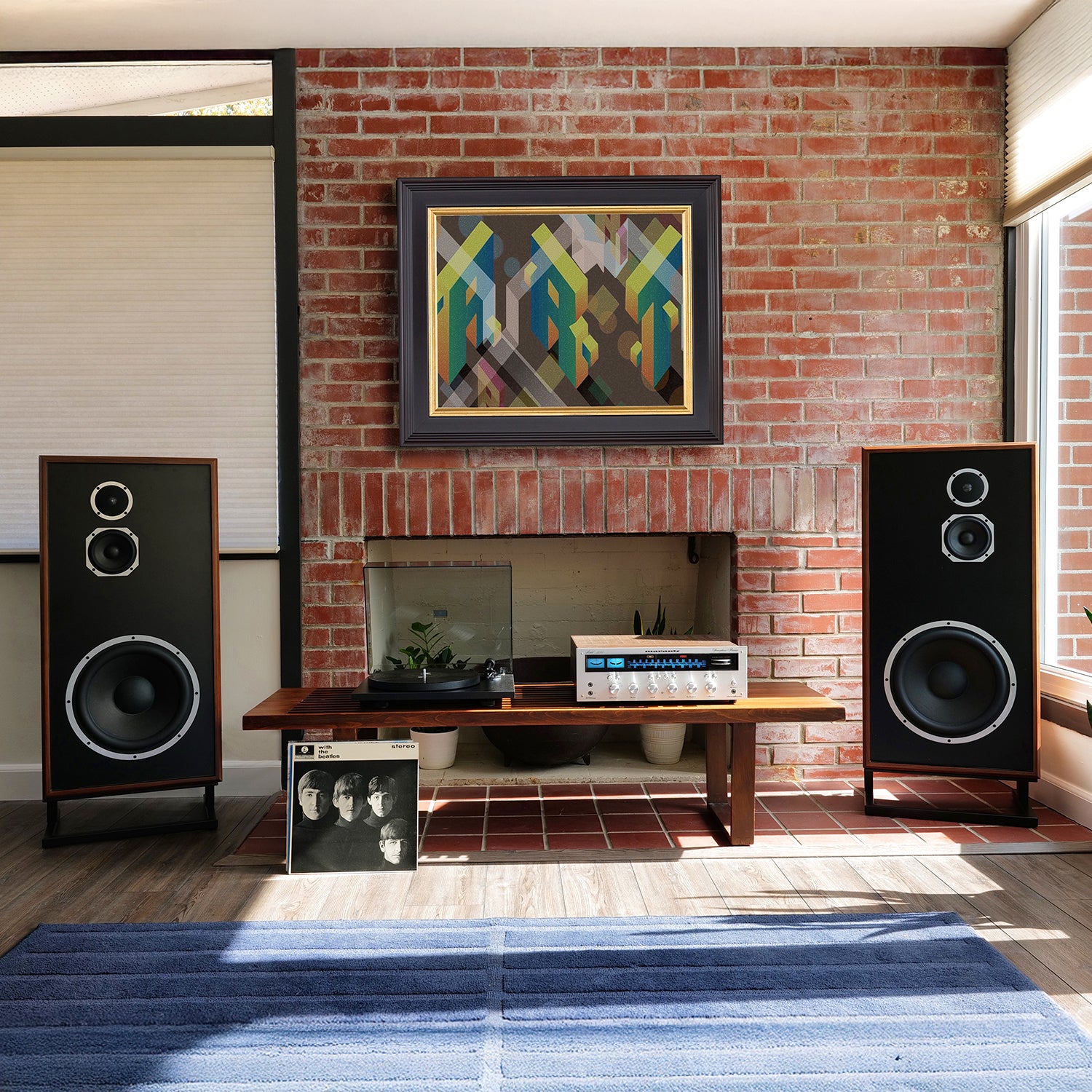
Model Seven delivered the bass tones with exquisite precision, and both Geir and I were slightly shocked at how clearly the speakers were able to reproduce the deepest notes. Talk about tight control.
The speakers also shone with music of perhaps higher musical value, such as Norwegian Kari Bremne’s Det Kunne Skjedd. The depth of the piano notes came out in all their rich splendour and the vocals were reproduced with a natural warmth. At the same time, the soundstage was extremely wide. Perhaps because the midrange and tweeter units were placed asymmetrically and both speakers were placed with the units on the outer edge. This resulted in the piano in Mozart’s Piano Concerto No. 5 being too wide, for example. In the same way that Kari’s vocals were stretched across a screen in cinemascope format.
It was hugely effective, but what if? The speakers swapped places so that the midranges and tweeters were now positioned closer to the centre. And it worked. Focus improved and both vocals and piano were placed much closer to the centre of the soundstage.
This meant, for example, that the sound of Rage Against The Machine wasn’t reproduced in a Wall Of Sound, but the new placement gave the sound a better focus and a deeper sound.
Harry Belafonte’s legendary live concert from Carnegie Hall was one of the many recordings to benefit from the new location. The 1959 recording is old, but sounds exceptionally good, and the live feel was frighteningly realistic. The KLH speakers presented the music with a three-dimensionality that is rare in this price range. Both Geir and I sat in awe of the realism the speakers recreated on the old recording.
Much more recent recordings, such as Espen Eriksen Trio’s 1974, were reproduced with razor-sharp precision, and both the piano and Andy Sheppard’s saxophone had an incredibly believable depth of sound. The bass drum was reproduced with an authority indicative of a well-tuned cabinet – acoustic suspension, anyone? – and bass notes were reproduced with a precision that we rarely hear in this price range.
In other words, you get a huge soundstage, filled with dynamic playfulness that makes every listen a small event. It’s simply hugely satisfying to play music on a speaker that’s built more for musical enjoyment than for monitor-like, cool and surgical precision. If you prioritise resolution and detail, a pair of Dynaudio, Piega or Audiovector might be interesting alternatives, but they also cost a lot more than a pair of Model Seven does.
Of course, not everything is perfect, and we would have liked a more airy treble. At times it can come across as a bit harsh compared to an AMT tweeter in an Audiovector or the diamond diaphragm that B&W uses. But interestingly, the grille dampens most of the slightly edgy treble reproduction, so perhaps the solution is to keep the grille on. They certainly look best with them.
Conclusion
The KLH Model Seven is a retro-inspired speaker with acoustic damping, built with modern materials. It delivers a large soundstage with rich bass and good control, but the treble can be perceived as a little harsh. The speakers are well built and easily driven, providing an engaging listening experience and, not least, offering excellent value for money. You can find speakers with other qualities in the same price range, but very few of them combine the warm, rich sound with such a dynamic and enormous soundstage as the Model Seven. Although this is not the last word in fine-tuned sophistication, they offer so much listening pleasure that it really does not matter.

We think
Phenomenally vivid soundstage with good dynamic contrast. Tight and controlled bass. Appealing sound qualities for pop, rock and classical music. Charming retro design. Quite substantial. Occasionally slightly harsh treble.
5990 €
Specifications
- Type: Three-way, floor/stand loudspeaker with acoustic suspention
- Woofer: 33 cm paper fibre cone
- Midrange: 12.6 cm paper fibre cone
- Tweeter: 25 mm aluminium
- Sensitivity: 91 (2.83V) /88 dB (1 W)
- Impedance: 4 ohms
- Frequency range: 38 Hz – 20 kHz (±3 dB), 26 Hz (-10 dB)
- Crossover frequency: 300 Hz, 3500 Hz
- Maximum sound pressure: 115 dB
- Recommended amplifier power: 20-250 W
- Dimensions/weight (cm/kg): 104.1 x 31.1 x 45.7/30.8
- Colours: Mahogany, walnut
- Web: klhaudio.com