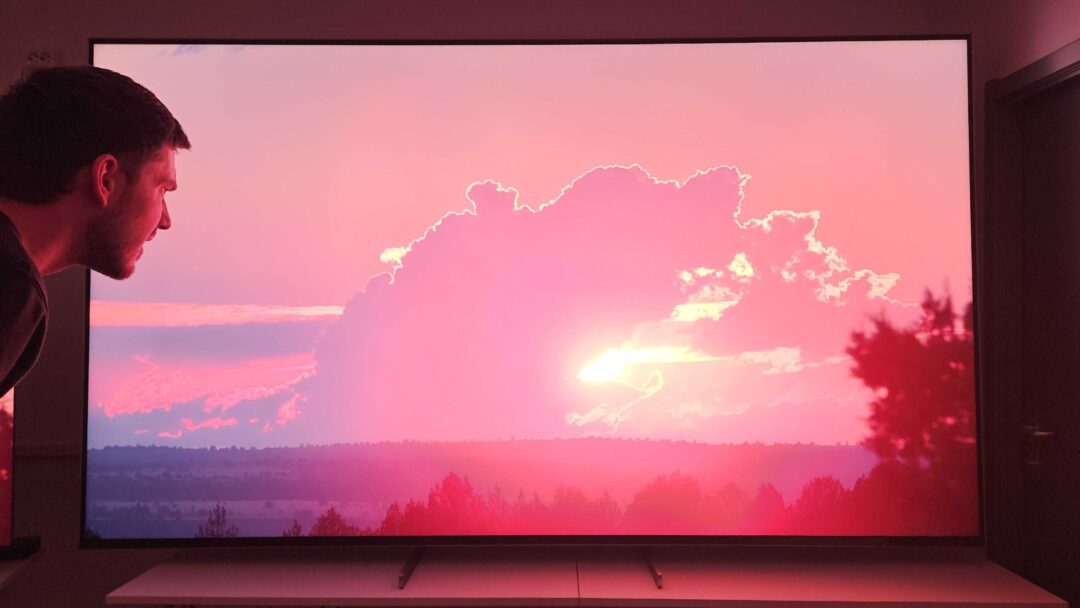

Samsung has long signalled that Micro RGB would be its next big venture in premium and high-end TVs – and now it’s here: the 115MR95F is the company’s first TV based on Micro RGB technology. The technology was shown for the very first time at CES 2025 and now, just over a year later, it has finally arrived in the Nordics. Shortly before Christmas, Lyd & Billede had the opportunity to be among the first to unpack and test it.

Normally we prefer to test the monitors in our own test room, but this time we made an exception for logistical reasons. Samsung provided a warehouse location where we could test the monitor in peace and quiet shortly before Christmas. In return, we were required to be present when it was unpacked!
That in itself is a task that requires both muscle and courage. Even though we’ve gained a lot of experience handling giant TV screens, we can safely say that there’s a big difference between 98 and 115 inches!
Micro RGB – a new chapter for LCD

Firstly, it’s worth clearing up some misunderstandings: Micro RGB is not the same as a MicroLED TV. It’s still an LCD TV, just with a new and modern type of backlight.
Samsung has been offering so-called MicroLED displays for years, where microscopic colour LEDs are used for every pixel. These modular screen walls are known for their outstanding contrast and colour depth, but have also proved extremely expensive to mass produce. With end prices in the millions, it seems almost unthinkable that anyone other than tech billionaires, oligarchs and lottery winners could afford a MicroLED TV.
With Micro RGB, however, Samsung has found another way to utilise MicroLED technology – as a backlight in an LCD TV. It’s far more cost-effective, as it requires fewer LEDs, but can still provide a significant improvement in picture quality.

Samsung calls the backlighting technology Micro RGB Matrix Pro and claims to have significantly reduced the size of the LEDs compared to the competition. The RGB-based LEDs consist of red, green and blue micro LEDs that are only 100 micrometres thick (0.1 mm) – about the size of a hair.
A colour-based backlight can have several advantages over the blue/white variant. In theory, the number of dimming zones is tripled because each LED contains three separate colour light sources. And because the backlight can emit the three primary colours directly, there is no need for a QLED colour filter. This allows for high luminous efficiency and contrast as well as a wider colour spectrum.
Samsung claims up to 100 percent coverage of the BT.2020 colour space, and keeping track of both colour and light naturally requires a high-end video processor. This is handled by a Micro RGB AI video processor that controls colour intensity, greyscale and brightness in real-time.
Samsung 115MR95F: Design and build quality
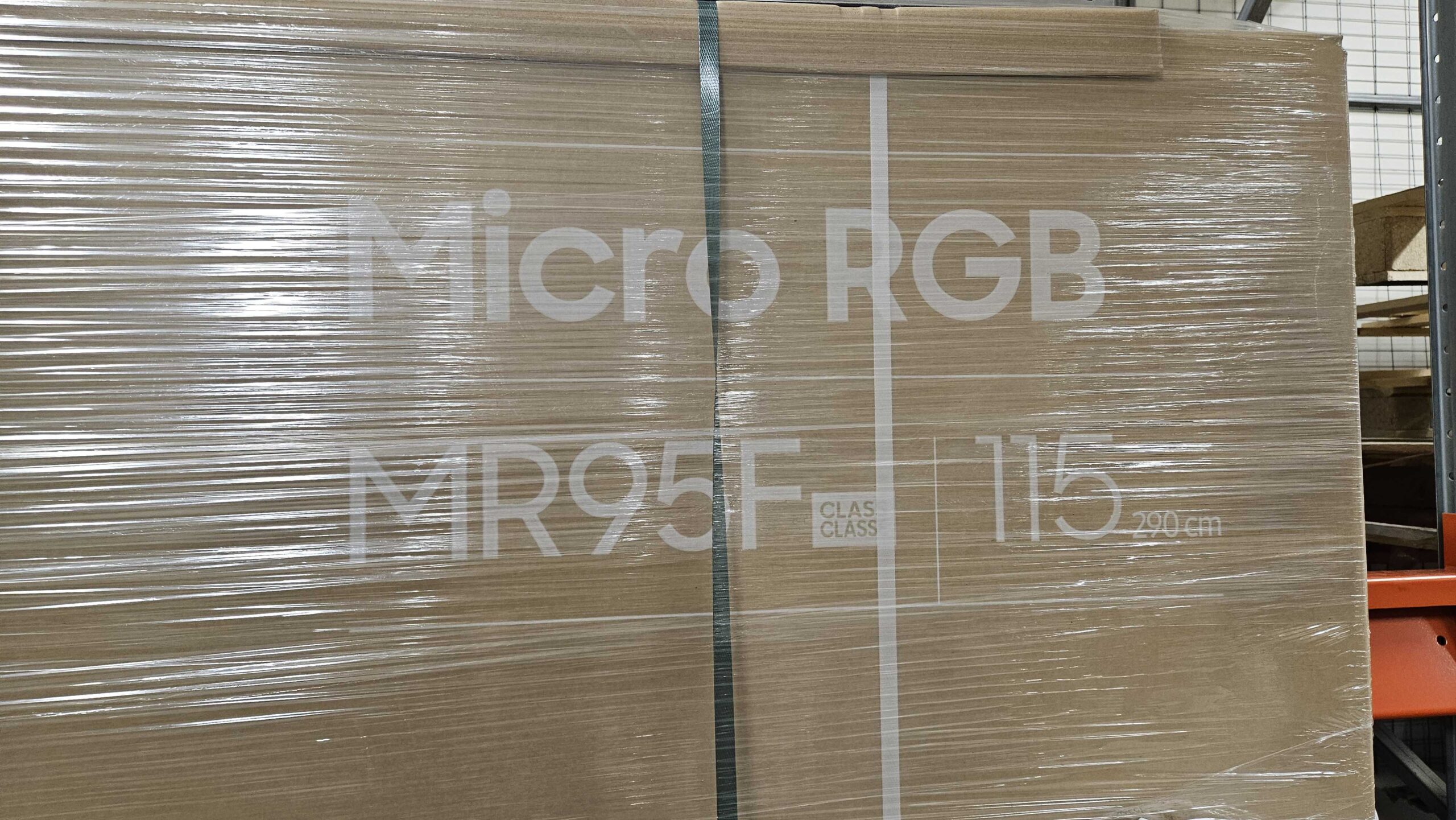
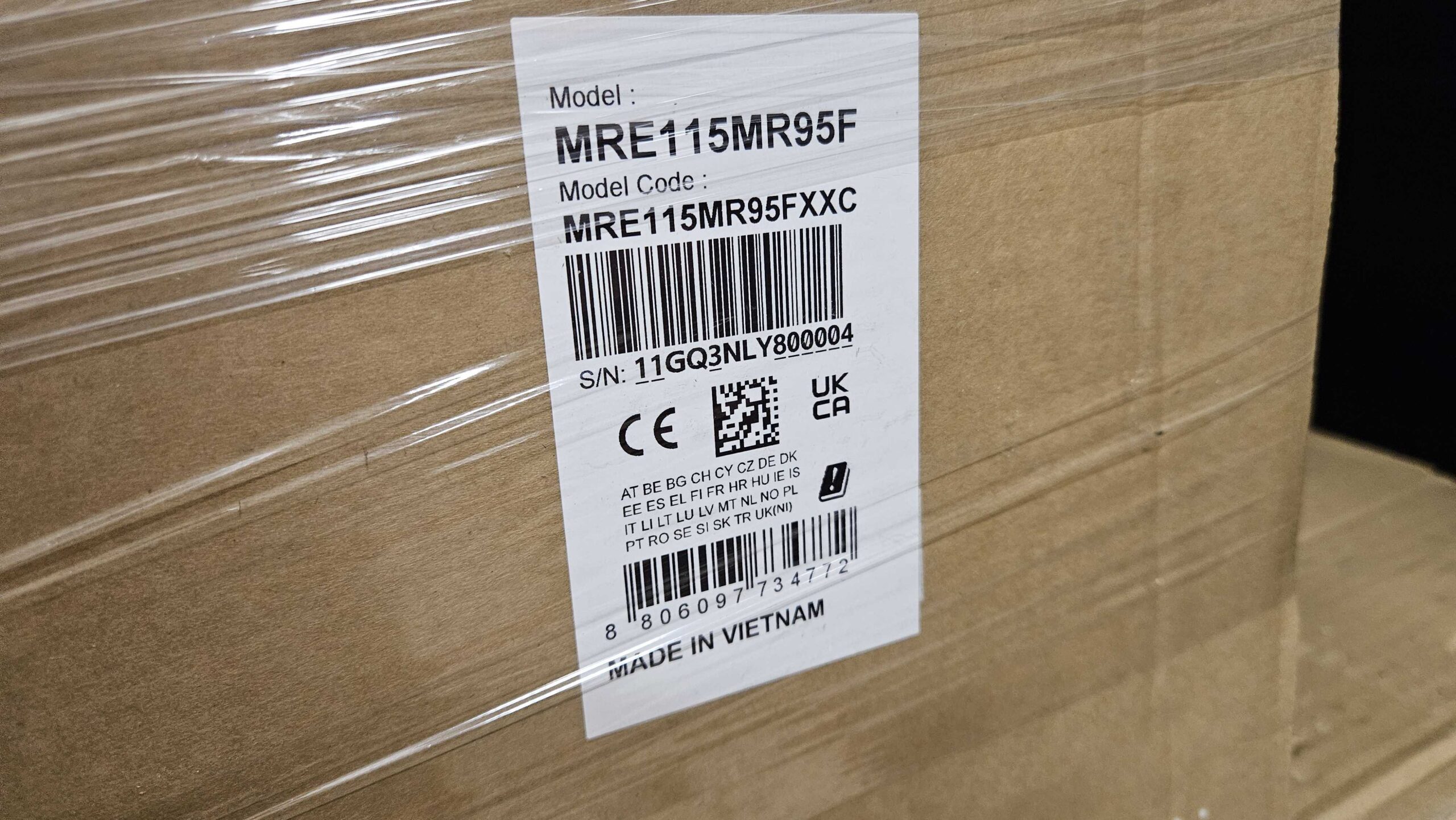
Needless to say, this TV is big, but it’s worth considering the packaging. The TV comes on a double Euro pallet and weighs around 120 kilos including packaging. If you live high up in a penthouse apartment, you’ll probably need a crane – it’s far from certain that the elevator is big enough.
Fortunately, Samsung has made the packaging easy to remove, and the feet can be clicked on while the monitor is still in the box – no screws required. The feet can be mounted narrow or wide depending on the width of the TV cabinet. The Samsung 115MR95F also comes with practical transport handles that need to be screwed on before lifting.
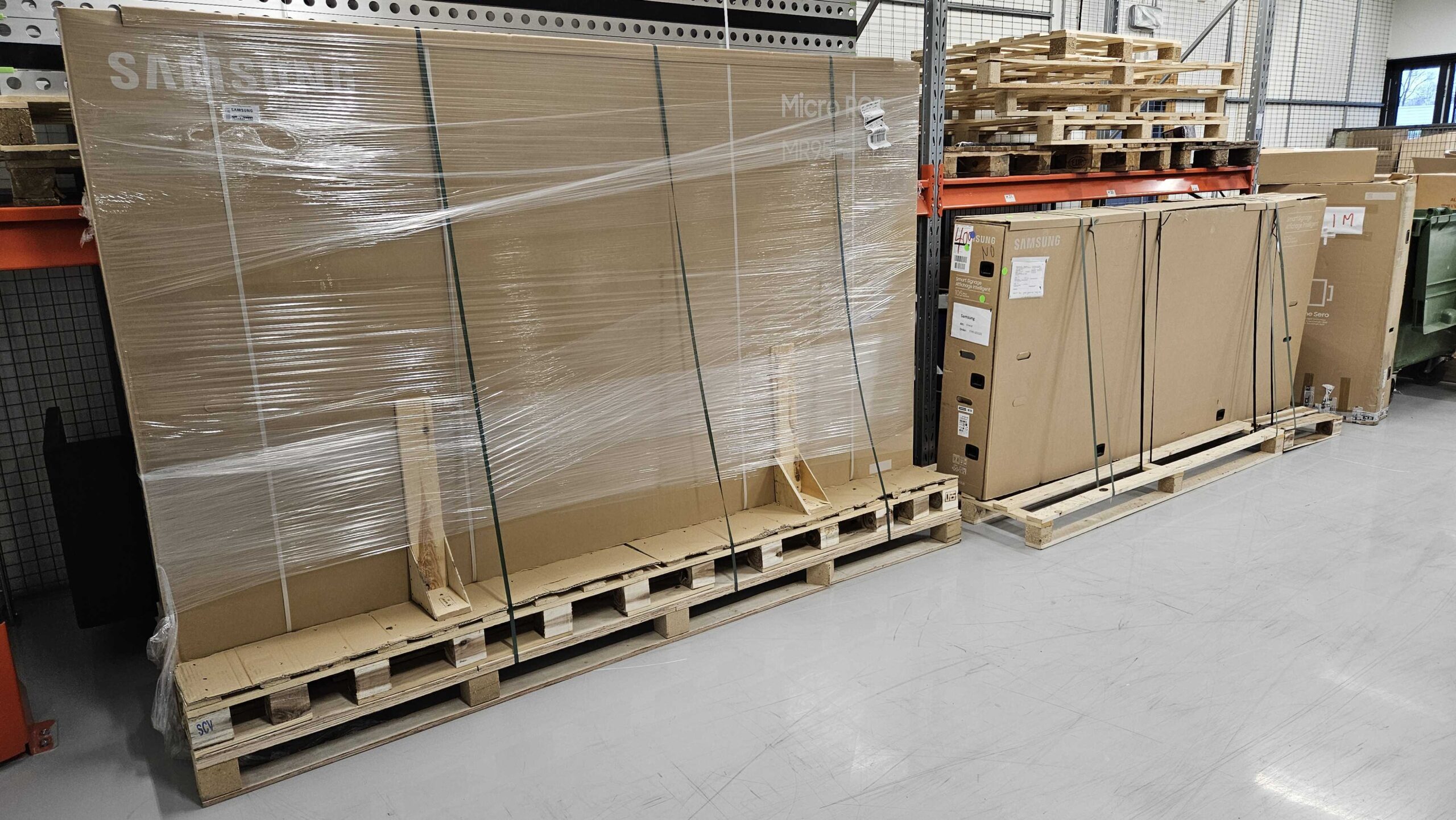
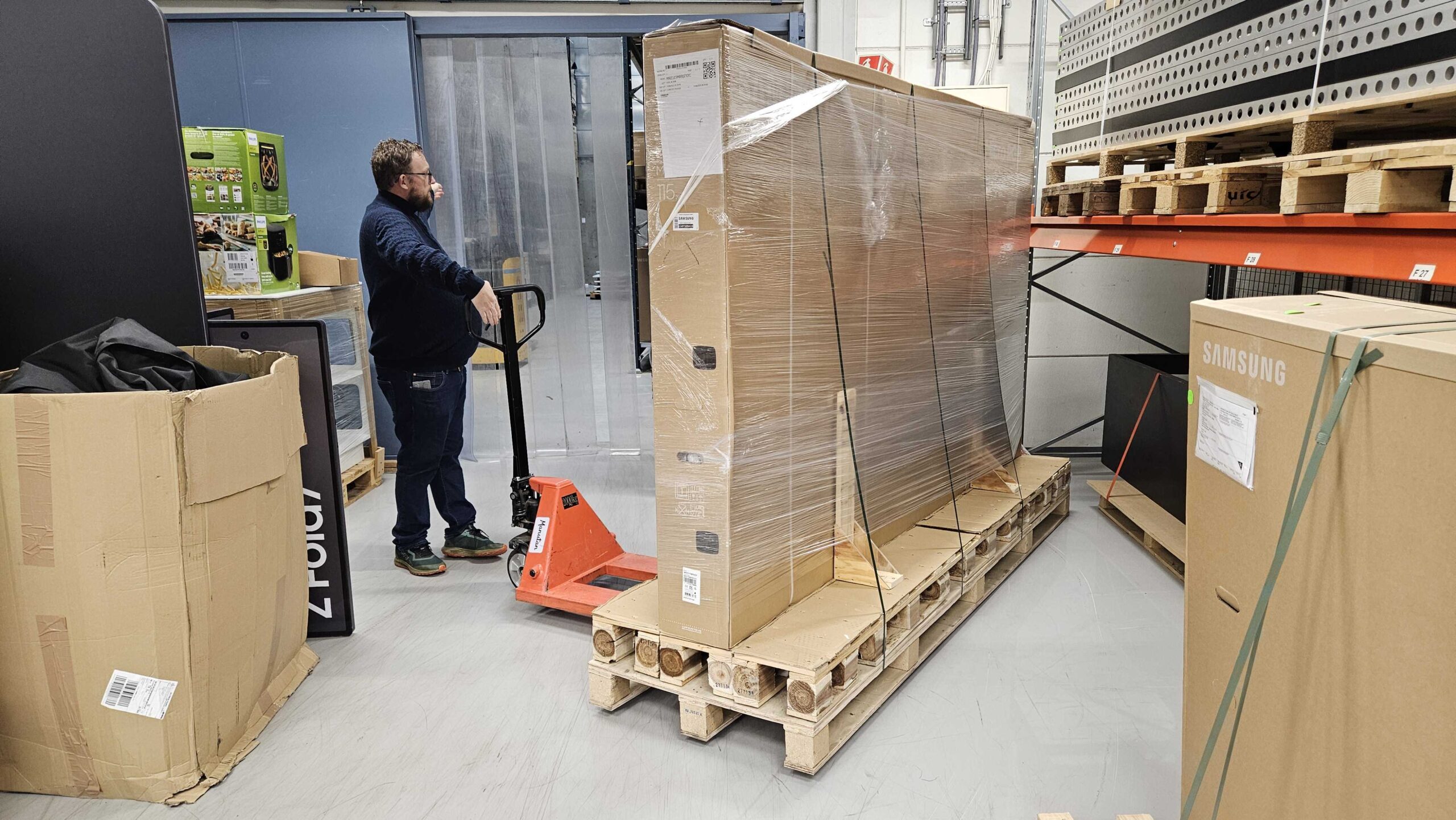
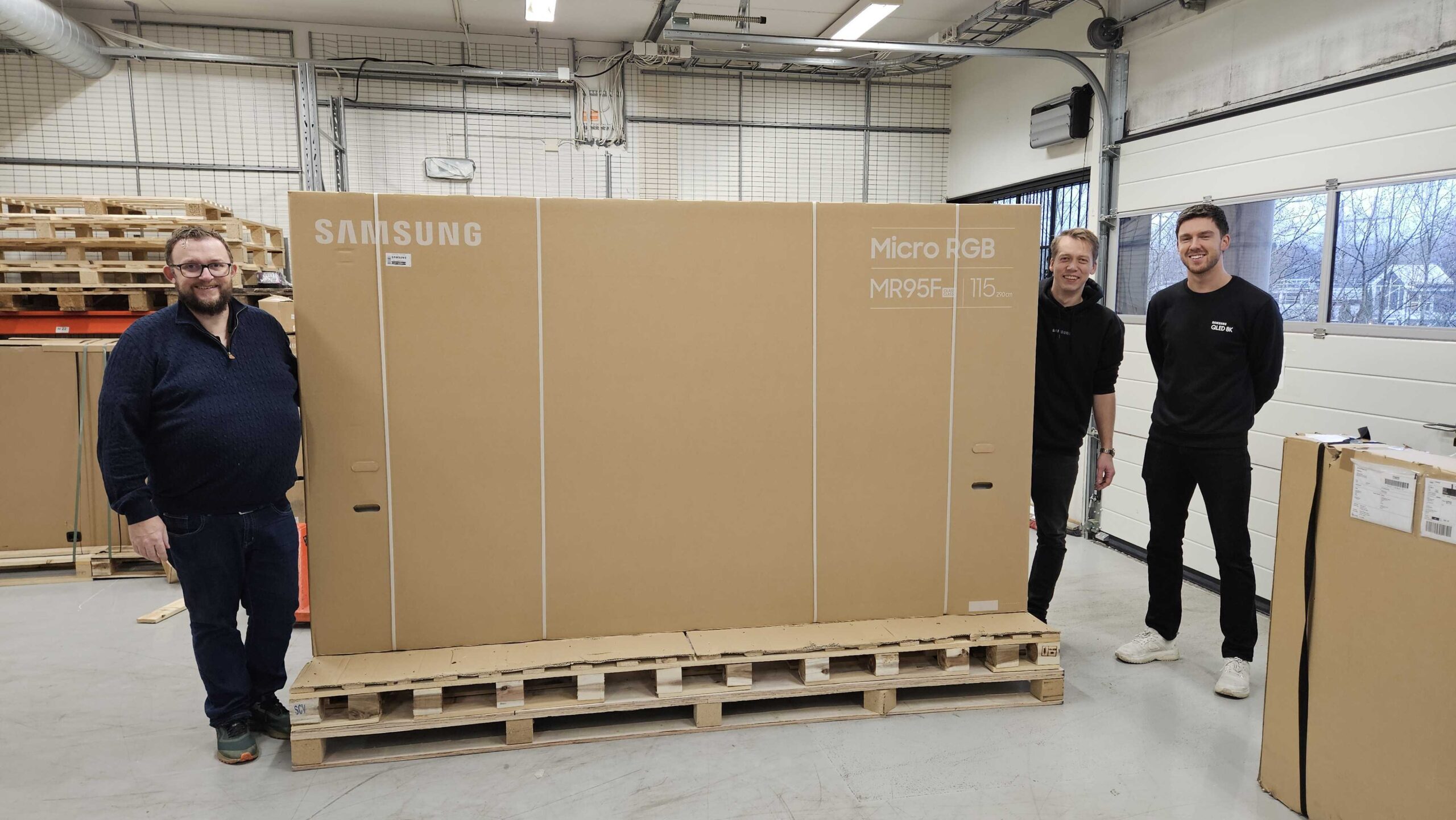
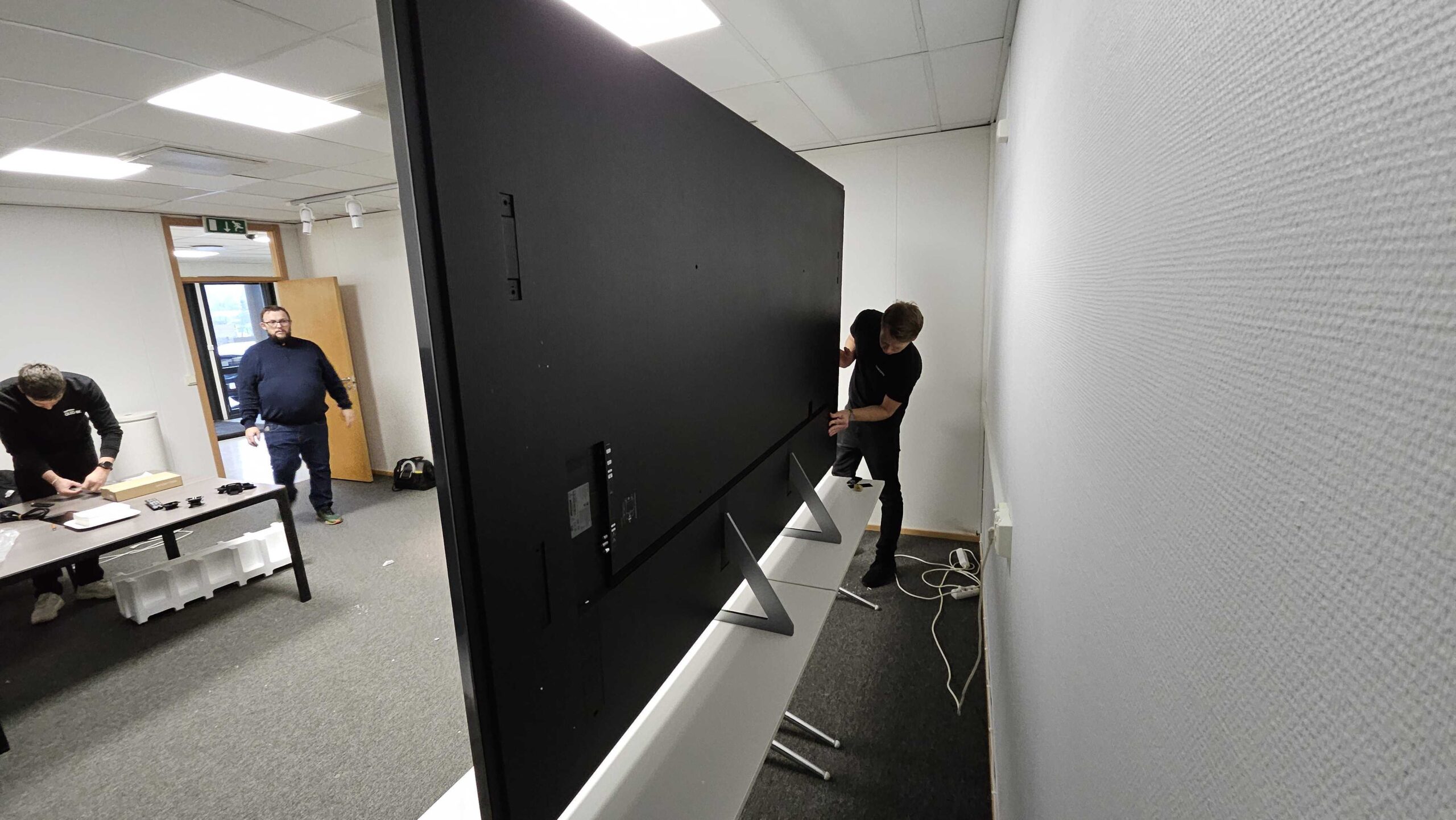
When the TV is first placed on the bench, the impression is immediate: this is something completely different from a 98-inch and comes even closer to the true cinema experience. The 65-inch we set up next to it looks almost like a ‘bedroom TV’ in comparison.
Despite the massive screen size, the MR95F is only 3.4cm thick, completely flat and with a relatively minimalist frame. The image extends almost to the edges. The slim T-shaped feet can be mounted wide or narrow, so it’s possible to place the TV on a relatively narrow piece of furniture – as long as it can support 90kg.
However, Samsung has – somewhat surprisingly – chosen to drop the popular One Connect box on the MR95F. We suspect this is due to the power consumption of the screen. This makes connecting external video sources more difficult, especially if the TV is wall-mounted. An external box – especially the wireless version – would have been very handy on such a heavy screen.
Ease of use and features

The 115MR95F uses Tizen with One UI – the same operating system and user interface that we know from Samsung’s other TVs. It’s just as easy to use here, not least because you can adjust the size of the on-screen menus. The app selection is impeccable and the menus respond quickly.
As mentioned, Samsung has dropped the One Connect box, but the screen is equipped with four HDMI inputs, all of which support 4K/120 Hz. The Micro RGB panel is also well equipped for gaming with a dedicated Game Bar packed with customisation options. We measured input lag at 17 milliseconds – respectable, but not record low. This may be because the image processing requires a few extra milliseconds to keep track of the many small MicroLEDs.
On the format side, HDR10+ is of course supported and is becoming increasingly widespread. However, Samsung still shows no willingness to support Dolby Vision – not even in the upcoming variants. This is a shame, as it could have been an advantage on such a capable screen.
Samsung has equipped the MR95F with the latest gaming features, including Game Bar, VRR and fast gaming mode. Here we measured input lag as low as 14 milliseconds.

Picture quality
With brand new, state-of-the-art technology under the bonnet, it’s naturally the picture quality that’s most interesting. What kind of viewing experience can you expect from what is technically Samsung’s flagship TV entering 2026? There’s no need to beat around the bush: this is one of the sharpest TV images we’ve seen.
We already have plenty of experience with Hisense’s top model 116UXQ, which has shown what RGB MiniLED technology is capable of. However, Samsung has managed to raise the bar further in some areas – although not necessarily all of them.
The first thing we notice when the Samsung display powers up is an extremely impressive sharpness. Subjectively, this is one of the sharpest TV images we’ve experienced – including the most advanced 8K OLED displays.
We didn’t expect sharpness to be one of the most impressive aspects of this TV.
Even with Samsung’s own 8K QN990F standing next to it – albeit ‘only’ the 65-inch – the Micro RGB display manages to deliver an even clearer and more detailed picture. It shows how much image information is actually contained in a 4K signal when the conditions are right.
The picture is razor-sharp and very pleasing to the eye. Samsung shouldn’t write off 8K on future models though, because when 4K can look this good, it’s hard not to be curious what an 8K version of Micro RGB will look like!

Super precise backlighting
According to Samsung, the MicroLED backlight should have several technical advantages over the MiniLED backlight, including the latest RGB variant when it comes to contrast and lighting control. With a larger number of LEDs per given screen area, the light distribution should also be more precise, and during the test we saw several clear examples of this.
The 115-inch delivers an impressively even and precise light distribution. There is no hint of dirty screen effect, nor did we observe any irregularities such as clouding or vignetting. The light is distributed evenly across the entire screen surface, from the centre to the edges, with no shadows or dark areas. This is of course a clear advantage on a monitor of this size.
During the short but intensive test period, we challenged the Samsung display with many different types of TV entertainment, video content and test sequences, and it handled most of them with ease. Football was particularly convincing, and we’ve rarely been closer to a real stadium experience than here – without sitting on a plastic seat with a beer and a hot dog.
The Samsung screen gave a razor-sharp view of the action on the pitch with smooth and precise movements, and when the camera panned across the grass, there was no sign of lag in the backlight. At times, you could almost forget you were watching TV, even without any loyalty to the teams – I swear.
The gigantic screen is also in its element when showing feature films and series, whether in 2.35:1 or full-screen 16:9 format. The black bars above and below the image remain deep black, and with a 115-inch screen, you retain a large enough image area that the cinema experience is not lost. It feels like sitting in the best seats in your own private cinema.

Full matte ‘Glare Free’ display with generous brightness
Another important detail is that the screen surface is completely matte – Samsung’s ‘Glare Free’, which we know from The Frame and other models. It makes a significant difference on a screen of this size. Instead of acting like a giant mirror, the panel absorbs light from the surroundings and therefore gives far fewer annoying reflections from lamps and windows. This was something we noticed when we previously had the competitors Hisense 116UXQ and TCL 115C7K for testing.

The brightness is certainly impressive, but not exactly boundary-pushing: the Samsung monitor delivers over 3,000 nits in a small 10 per cent window and just over 800 nits across the entire screen simultaneously. However, this is lower than what the Hisense 116UXQ managed on the test bench (4,800 nit / 900 nit). One possible explanation is that the very small MicroLED diodes do not necessarily perform as strongly with a pure white test signal as the larger MiniLED diodes. It is also possible that Samsung has deliberately prioritised more neutral colours.
However, one thing is certain: The Samsung MR95F delivers a very convincing colour reproduction that you almost have to experience to truly appreciate. Both colour saturation and richness of hue are impressive. That said, there’s still a way to go to reach the level you can experience with true MicroLED displays without a front LCD layer. In our experience, these can deliver even more intense colour saturation than the MR95F – but they also cost at least three times as much.
Therefore, it makes more sense to compare with another RGB-based monitor like the Hisense UXQ. Here the performance is closer and both TVs deliver very convincing colour reproduction.
On the other hand, Samsung has achieved even more precise and finer local dimming than the Chinese competitor. The light control is extremely sharp and accurate, almost at OLED level, with only a very slight hint of halo effect around bright objects. It’s present, but almost requires a magnifying glass to detect. The result is a very impressive black level.
In addition, Samsung has achieved very high quality in both upscaling and general image processing on the MR95F. During the test we worked with everything from 4K HDR to older SDR material, and even old episodes of Top Gear and Baywatch from the free Samsung TV+ service looked surprisingly decent on the 115-inch.
Sound quality
The sound reproduction, on the other hand, is nothing to shout about. The MR95F does have a 4.2.2 channel speaker system. It consists of strategically placed speakers around the screen and additional woofers on the back and promises a total power output of 70 watts. Even so, there is significantly less power in the sound than you would expect from a high-end TV in this class. Speech intelligibility is quite good, but the overall sound experience is very slim and doesn’t match the impressive picture.
Samsung is probably counting on the vast majority of buyers to switch off the built-in speakers and instead invest in a separate sound system – for example, a soundbar like the HW-Q995F or an actual surround system.
Still, a little more punch in the built-in sound wouldn’t have hurt, we reckon – after all, the TV costs close to thirty thousand Euros.
Conclusion
After seeing the world’s first Micro RGB TV in action up close in an extended test session, we can say that the Samsung 115MR95F is a magnificent sight – and one of the sharpest and most colourful LCD monitors we’ve tested. For those looking for a monitor for discerning home theatre and crazy sports bonanza, this could be the model for you.
Micro RGB shows that LCD technology is still alive and kicking, and combined with the massive screen size and matte panel, you get a fantastic viewing experience. This is definitely a technology that can challenge OLED in several areas.
The sound, on the other hand, could definitely be fatter. For a €28,000 TV to deliver such anonymous sound is just a little disappointing. We also think many Samsung fans will miss the convenient One Connect box on a powerful home cinema screen like this.
The price is still high, and we may have to wait a while before Micro RGB displays become more widely available to the average consumer. That being said, we have exciting things in store for the new year: Samsung recently announced that it will be launching more Micro RGB displays as small as 55 inches in 2026.
One thing is for sure: We’re definitely in for a colourful TV year!

We think
The Samsung MR95F delivers a groundbreaking viewing experience with phenomenal sharpness, extreme brightness and contrast, precise dimming and stunning colours. The sound reproduction is relatively thin for a screen of this calibre. Samsung has dropped the popular One Connect box on this model.
27999 €
Specifications
- Type: Micro RGB LCD
- Resolution: 3840 × 2160 (4K Ultra HD)
- Panel frequency: 60-144Hz
- Operating system: Tizen/One UI
- Inputs: 4 HDMI (4 x 2.1), 3 USB
- Outputs: Optical digital audio output, HDMI eARC
- HDR: HDR10+
- Screen sizes: 115″
- Other: Micro RGB AI video processor
- Web: samsung.com